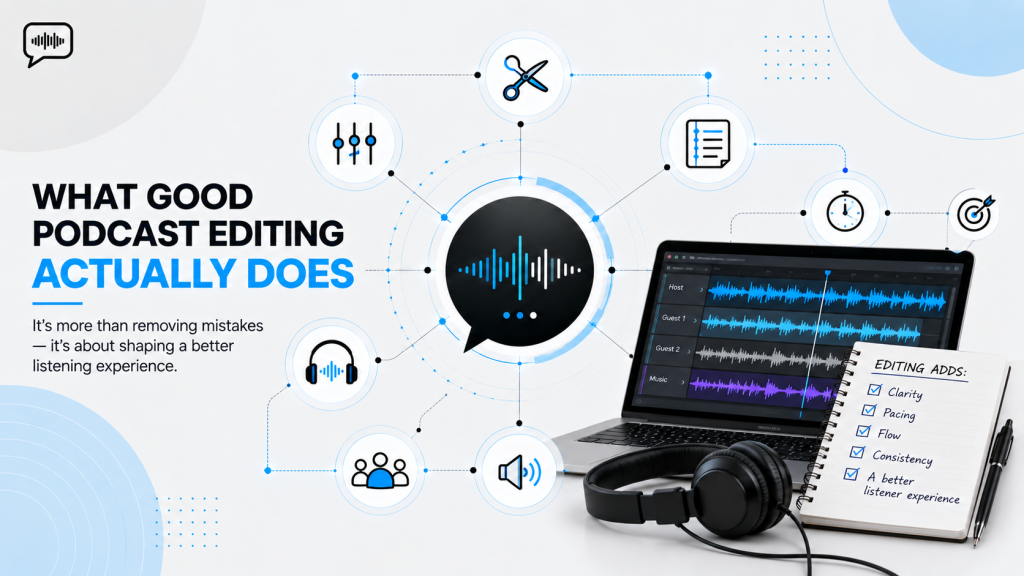
Podcast editing is often described in fairly mechanical terms.
Remove the ums. Cut the mistakes. Take out the awkward pauses. Make everybody louder. Add the music. Export the episode.
All of those things can be part of the job, but they are not really what makes an edit good.
For me, good podcast editing is mostly about judgement. You are listening to a conversation that has already happened and deciding what the listener actually needs from it. Where does the episode move well? Where does it wander? Which moments deserve more space? Which sections felt useful in the room but become repetitive once you hear them back?
The best edit usually does not announce itself.
You just hear a conversation that feels easier to follow.
The recording and the episode are not the same thing
This is probably the most useful distinction to make.
A recording is what happened.
An episode is what the listener needs to hear.
Sometimes those two things are remarkably close. You record a strong forty-minute conversation, remove a technical interruption, tidy the opening and ending, and very little else needs touching.
Other recordings need considerably more shaping.
A guest may answer the same point in three different ways before arriving at the clearest version. A conversation might take ten minutes to settle down. There may be a useful discussion buried between two sections that do not really lead anywhere.
None of that means the recording was bad.
Real conversations are messy. People think while they speak. They change direction. They remember something halfway through an answer and go back. Hosts ask questions that seem useful at the time and turn out not to add much once you listen again.
Editing gives you another opportunity to decide what the episode actually is.
Start with the conversation, not the waveform
Audio software makes it very easy to look busy.
There are waveforms, markers, plugins, meters and dozens of ways of manipulating sound. You can spend a long time making tiny technical changes before asking the more important question:
Is this conversation working?
I prefer to listen first.
Where does my attention drift?
Which answer makes me want to hear what comes next?
Is there a section that explains something especially well?
Does the episode begin in the right place?
Those decisions affect the listener far more than whether one breath is three decibels louder than the breath before it.
The waveform is useful, but it cannot tell you which part of the conversation matters.
You still have to listen.
Cutting everything is not the goal
There is a particular style of editing where every gap disappears.
Sentences are pushed tightly together. Breaths are removed. Any hesitation longer than a fraction of a second is cut away.
It can create energy, and there are formats where that pace works well.
But it can also make people sound slightly unnatural.
Pauses are part of speech. Sometimes somebody stops because they are thinking. Sometimes a moment of silence gives an answer more weight. Laughter often needs a second to land. A guest telling a personal story may sound much more believable when the listener can hear them finding the words.
If every trace of that is removed, the edit may be technically clean while the person speaking starts to sound less like themselves.
I would rather edit for rhythm than for maximum density.
That means some pauses stay.
Some breaths stay.
Some small imperfections stay.
The question is whether they help or hinder the experience.
Repetition is often where the biggest gains are
One of the easiest ways to shorten an episode without losing anything useful is to listen for repetition.
People repeat themselves constantly in conversation.
They make a point, explain it, give an example, then make the original point again because that is how natural speech works.
In the room, you often do not notice.
During an edit, it becomes obvious.
Removing one of those repetitions can make an answer feel much sharper without changing what the speaker meant. The listener gets the same idea in less time.
This is very different from editing somebody into saying something they did not say.
The substance remains theirs.
You are simply finding the strongest route through it.
That is one reason I like to think of editing as giving time back to the listener. If a five-minute answer contains three genuinely useful minutes, there is little value in making somebody listen to all five just because that is how long the original response happened to take.
A good edit protects meaning
There is a responsibility here too.
When you remove words, sentences or entire sections, you change the context around what remains.
Most of the time that is harmless. A repeated example goes. A false start disappears. A long diversion about somebody’s train journey never makes the final episode.
But sometimes a cut can change the meaning of an answer.
A qualification gets removed and suddenly a cautious statement sounds definitive. A joke disappears and the following sentence feels unexpectedly serious. Two separate parts of a conversation are joined together and the speaker appears to be responding to something they never actually heard.
That is where editorial judgement matters.
The objective is to improve the episode while remaining faithful to the conversation that actually took place.
If the edit makes somebody sound more articulate, concise or confident, that can be perfectly reasonable.
If it makes them sound as though they expressed an opinion they did not express, that is a different thing entirely.
The beginning deserves more attention than it usually gets
A lot of recordings begin before the episode really begins.
There is some settling in. The host explains what is about to happen. Everyone thanks each other for being there. The first question gets asked and the guest gives an answer that takes a little while to find its direction.
That may all have felt completely natural during the recording.
The listener has a different experience.
They have just chosen your episode from hundreds of other things they could be listening to. The opening needs to give them a reason to stay.
That does not necessarily mean starting with a dramatic clip or a heavily produced montage. Sometimes the strongest opening is simply getting to the conversation sooner.
A good edit asks whether the episode starts where the interesting part starts.
Quite often, it does not.
Pacing changes how long an episode feels
Two forty-minute podcasts can feel completely different in length.
One moves naturally from idea to idea. The other feels as though it has been going for an hour by the time you reach minute twenty.
That is pacing.
It is affected by the conversation itself, but editing has a large influence too.
If every answer is followed by a long reset before the next question, the episode can feel slow. If sections covering similar ideas sit far apart, the structure may feel repetitive. If the conversation stays on one subject after the useful part has finished, energy begins to disappear.
Sometimes the fix is a cut.
Sometimes it is moving a section.
Sometimes it is doing nothing because the slower pace suits the subject.
There is no universal speed a podcast should move at.
The important thing is that the pace feels intentional rather than accidental.
Moving material can be more useful than removing it
Editing is not always about subtraction.
Occasionally a conversation contains everything you need, just not in the most useful order.
A guest may explain an important piece of context twenty minutes after first referring to it. A host might return to a subject later and ask the question that would have worked better earlier.
Depending on the format, sections can sometimes be repositioned so the listener encounters information in a clearer order.
I would use this carefully.
Highly conversational interviews can start to feel strange if they are rearranged too heavily. You can lose the natural logic of how people respond to one another.
But in more structured formats, documentaries, narrated pieces or episodes built from several contributors, moving material around is a normal part of making the story work.
Again, the listener is the reason for doing it.
Cleaning the audio is only one part of the edit
There is still a technical job to do.
Background noise may need reducing. One microphone might contain a hum. A remote guest could have recorded at a much lower level than the host. There may be clicks, plosives, mouth noise or other distractions worth dealing with.
EQ and compression can help voices sit more comfortably together. Automation can smooth out level changes. De-essing can deal with harsh sibilance. Noise reduction can rescue sections recorded in less-than-ideal environments.
These tools matter.
But they work best when they solve actual problems.
I do not process a voice because a plugin exists. I process it because there is something about the recording that would otherwise distract the listener or stop the voices sitting together properly.
That is the same principle behind Good Podcast Production Needs More Than Good Equipment. Technical tools are valuable when they support the experience rather than becoming the point of the production.
Different voices should still sound like different people
This is especially relevant with remote recording.
You may have one person using a studio microphone in a treated room, another using a USB mic in a home office and somebody else recording in a room with a little more reflection.
The finished episode should feel coherent.
That does not mean every voice needs to sound identical.
Trying to force very different recordings into exactly the same tonal shape can sometimes make them sound worse.
I am more interested in whether the differences are distracting.
Are the levels consistent enough that the listener is not reaching for the volume control? Does one voice suddenly sound enormously brighter or more distant than everyone else? Is background noise drawing attention away from what somebody is saying?
The objective is compatibility, not uniformity.
People are allowed to sound like people.
Music should help with structure or identity
Music is another area where editing and production overlap.
An introduction can give the podcast an identity. A short transition might help separate sections. Music underneath narration can sometimes create movement or atmosphere.
It can also become wallpaper surprisingly quickly.
I would always ask what the music is contributing.
If the answer is simply “podcasts usually have some”, that is not especially convincing.
A strong edit may need almost no music at all. In other formats, music is central to the way the story is told.
What matters is that it has a job.
The same applies to stings, effects and transitions.
Production elements should help the listener understand where they are, recognise the programme or experience a particular moment more effectively.
They should not be there because an empty track in the session looked lonely.
Video makes invisible edits visible
Audio gives editors a useful advantage.
You can remove part of a sentence, tighten a pause or join two sections together and the listener may never know anything happened.
Video is less forgiving.
If somebody’s head suddenly moves position halfway through a sentence, the edit becomes visible immediately.
That is why multi-camera video podcasting requires a slightly different editing approach. A second camera angle can cover an audio edit. A reaction shot might make a transition feel natural. Sometimes a cut simply has to remain visible because pretending otherwise would be more distracting.
This is one of the reasons video increases the production work even when the conversation itself is unchanged.
The editorial decisions are often the same.
The visual problem created by those decisions is new.
Do not edit personality out of the podcast
This is probably the thing I am most cautious about.
A technically perfect edit can still be a boring one.
If every laugh is shortened, every tangent removed, every unusual turn of phrase corrected and every moment of hesitation cleaned away, the result may be efficient but strangely anonymous.
Some of the parts that look unnecessary on a transcript are exactly what make somebody enjoyable to listen to.
A small aside might reveal personality.
A slightly ridiculous story may tell you more about a guest than the perfectly prepared answer that came before it.
The challenge is knowing which tangents create character and which ones simply make the listener wait for the conversation to get back on track.
There is no plugin for that.
You have to listen and decide.
Good editing should be difficult to notice
There are exceptions, particularly in highly produced narrative podcasts where the edit is intentionally part of the style.
For most conversational podcasts, though, I am happy when the editing disappears.
The listener does not need to know that twelve minutes came out of the recording.
They do not need to hear the noise reduction working or notice where two answers were brought closer together.
They should hear people they are interested in talking about something worth listening to.
The episode should feel like it always existed in that form.
That usually means quite a lot of small decisions have happened underneath it.
The aim is the strongest honest version of the conversation
That is probably the simplest way I can describe good podcast editing.
Not the shortest version.
Not the cleanest possible version.
Not a version where every speaker suddenly sounds as though they have never paused to think in their life.
The strongest honest version.
Keep what makes the conversation useful, interesting or human.
Remove what gets in the way.
Improve the sound enough that the listener can stop thinking about the recording.
Then know when to leave it alone.
Good editing is partly about what you can change.
A lot of the craft is knowing what you should not.