Oracy can sound quite abstract when you describe it as a skill.
Speak clearly. Listen carefully. Ask useful questions. Explain your ideas. Take turns. Respond to what somebody else has said.
All of those things matter, but pupils are more likely to understand why they matter when they need them for something.
That is one of the things I like most about podcasting and oracy.
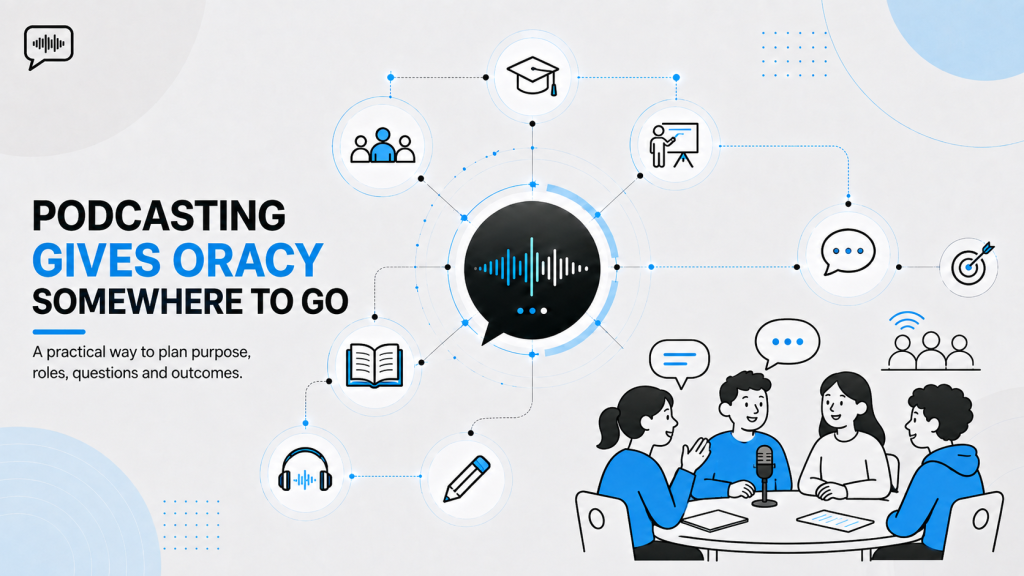
A podcast gives speaking and listening somewhere to go.
There is an audience at the other end of the process, even if that audience is initially just another class, parents or the rest of the school. Somebody needs to understand what is being said. Questions need answers. Ideas need explaining. People need to listen to each other closely enough for the conversation to move forward.
The communication has a job.
Having an audience changes the conversation
Ask somebody to explain a topic to their teacher and they already share quite a lot of context.
The teacher knows what was covered in the lesson. They know the vocabulary. They probably know what the pupil is trying to say even when the explanation is not completely clear.
A podcast changes that.
If somebody else might hear the recording, pupils have to think more carefully about what the listener knows.
Can we assume they understand this term?
Do we need to explain what happened first?
Why would they care about this part?
Does our example actually help?
That audience awareness is a useful communication skill in its own right.
The pupil is no longer speaking simply because an adult has asked a question.
They are trying to make another person understand something.
Good questions need listening as well as speaking
Interviewing is one of the most obvious ways podcasting can support oracy, but the interesting part is not simply writing a list of questions.
It is what happens after the first question has been asked.
A pupil might have prepared:
What made you interested in this subject?
The guest answers and says something unexpected.
Does the pupil move directly to question two because that is what the sheet says, or do they recognise that the interesting conversation is somewhere else?
A useful follow-up question depends on listening.
What did the person actually say? Is there something worth exploring? Did part of the answer need clarification?
That is a very different skill from simply taking turns to speak.
The strongest interviews feel like conversations because the next question is connected to the answer that came before it.
Podcasting gives pupils a reason to practise that.
Explaining something reveals whether you understand it
There is a familiar moment when you think you understand something until you try to explain it to somebody else.
Pupils experience the same thing.
A concept might feel clear while it is sitting in a textbook or on a classroom board. Turning it into spoken language exposes the gaps.
Where do I start?
Which part needs explaining first?
What does that word actually mean?
Can I give an example?
If the explanation becomes confusing, another pupil in the group may notice before the person speaking does.
That creates a useful conversation around the learning itself.
Podcasting is not doing anything mysterious here. It is simply creating a situation where understanding has to be communicated rather than privately assumed.
Speaking into a microphone is different
There is also something about the microphone.
Even when pupils know the finished recording is only a classroom exercise, pressing record changes the atmosphere slightly.
Words suddenly feel more permanent.
Some pupils become more deliberate. They think about volume, pace and whether the sentence made sense. They may ask to try an answer again because they heard themselves lose track halfway through.
That self-awareness can be useful.
It should not become pressure to perform everything perfectly, though.
One of the first things I try to establish in a workshop is that mistakes are normal. We can stop. We can record something again. We can edit.
Once pupils understand that, the microphone becomes less of a test and more of a tool.
Listening back is part of the learning
This is one of the most valuable parts of the process.
We rarely hear ourselves in the same way other people do.
Listening back to a recording gives pupils another perspective on their communication.
Was I speaking too quickly?
Could I hear everybody?
Did the introduction actually explain what the episode was about?
Did we keep interrupting one another?
Was there a section where nobody seemed sure what point we were making?
Teachers could tell pupils all of those things.
Sometimes hearing it themselves is more effective.
The reflection becomes connected to something they actually produced, rather than feedback on an isolated speaking exercise.
Oracy does not mean everybody has to become a presenter
This matters.
A podcast project can support speaking and listening without asking every pupil to sit behind a microphone for ten minutes.
Some will enjoy presenting immediately.
Others may be happier preparing questions, researching a topic, helping structure the episode or taking responsibility for recording. A pupil who is less confident speaking to a large group may be perfectly comfortable asking one prepared question in a smaller recording environment.
There are ways into the activity.
Over time, roles can change too.
Someone who begins by researching may decide to record a short section. A pupil who initially wants to present everything may discover that listening and asking follow-up questions is harder than expected.
The project gives those skills somewhere practical to develop.
Conversation requires collaboration
A group podcast is difficult to make completely on your own.
People have to decide what the episode is about. They need to agree who is doing what, what order things should happen in and when somebody else’s idea is better than the one they had originally.
Then they have to record together.
That means taking turns, making space, recognising when someone is trying to contribute and dealing with the inevitable moment when two people start speaking at once.
Those are ordinary features of conversation.
They are also part of learning how to communicate with other people.
The podcast gives the group a shared reason to work them out because they can hear the result when they do not.
The finished episode creates a useful standard
There is a difference between completing an activity and making something you know another person might encounter.
The second tends to introduce a little more care.
If the episode is going to be played to the class, shared with parents or used somewhere within the school, pupils have a reason to think about whether it is understandable and worth listening to.
That does not mean everything needs to sound professionally produced.
The value is in having an outcome that exists beyond the worksheet.
Research has contributed to something.
Questions have led to a conversation.
Speaking and listening have produced an episode.
There is a reason for each stage of the work.
Podcasting can sit alongside existing oracy work
I would not position podcasting as a replacement for the other ways schools develop speaking and listening.
Class discussion, presentations, debate, questioning and collaborative work all do different things.
Podcasting adds another context.
It can be particularly useful because several skills happen together. A pupil may research a topic, decide how to explain it, practise a question, listen to an answer, respond to somebody else and then reflect on the recording afterwards.
That is a lot of communication wrapped around one relatively simple creative outcome.
And because podcasting can work across different subjects, those skills do not need to remain inside one particular lesson.
As I explored in A Podcast Doesn’t Have to Be an English Project, the subject can come first. The podcast simply creates a way for pupils to do something with what they have learned.
You do not need to publish it to make it real
The word podcast sometimes creates an unnecessary assumption that everything pupils record needs to end up publicly available.
It does not.
A recording can exist entirely inside the classroom.
It might be shared only with another group or played back as part of the lesson. Schools can decide whether anything should be published based on their own safeguarding, consent and communication policies.
The learning does not depend on Spotify.
What matters is that pupils understand there is a listener.
That can be enough to make the communication feel purposeful.
Give them something worth talking about
Podcasting alone will not make an uninteresting task suddenly fascinating.
The subject still matters.
If pupils have nothing useful to say, the microphone cannot solve that.
Start with a question, story, subject or problem that deserves some thought. Give pupils enough knowledge to explore it. Help them decide who they are speaking to and what that person might want to understand.
Then the oracy skills begin appearing because the task requires them.
They need to explain.
They need to listen.
They need to ask.
They need to decide what is worth saying and how another person is likely to hear it.
That is why I think podcasting works particularly well here.
It does not ask pupils to practise communication simply because communication is important.
It gives them something they want another person to understand.