Recording remotely can sometimes sound like the compromise you make when you cannot get everybody into the same room.
For The Grumpy Social Workers, it wasn’t.
When we started working with Siobhan Maclean and Soyeb Aswat on the series, one of the practical realities was that everybody involved was in a different place. We could have treated that as a problem to solve by finding a studio, choosing a city, coordinating diaries and bringing everybody together for recording days, but before doing any of that there was a much more useful question to ask.
Would putting everybody in the same room actually make this particular podcast better?
In this case, we didn’t think it necessarily would.
The thing that made the idea interesting was the relationship between Siobhan and Soyeb, the subjects they wanted to talk about and the way they naturally challenged, agreed with and occasionally wound each other up. Our job was to create a production process that gave that conversation the best chance of working, rather than automatically assuming that professional podcasting had to mean hiring a studio and putting two microphones on a table.
So we built the production remotely instead, and in this case remote podcast production turned out to be much more than a convenient way of getting everybody into the same conversation.
And that decision ended up shaping much more than where everybody happened to be sitting when we pressed record.
Remote wasn’t the cheaper version of the production
There is still a slightly strange idea around remote podcasting that the hierarchy goes something like this: a professional studio at the top, recording on location somewhere underneath that, and remote production as the option you fall back on when neither of those is possible.
That isn’t really how we look at it.
A studio can be absolutely the right choice. There are projects where being physically together changes the energy of the conversation, where the visual production is a major part of what is being created, or where a particular set, location or multi-camera approach adds something genuinely useful to the finished podcast.
But the recording method should come from the project rather than from a general assumption about what looks most professional.
For The Grumpy Social Workers, bringing three people into one physical location would have added another layer of organisation without automatically adding anything to the conversations themselves. There would have been travel to arrange, diaries to coordinate, a studio to hire and recording dates that needed to work for everybody. That may still have been worthwhile if being in that room was important to the programme, but it wasn’t obvious that it was.
Siobhan and Soyeb already knew how to talk to one another.
We did not need to manufacture that chemistry by seating them opposite each other in a studio. We needed to give them a comfortable way of having the conversations they were already capable of having, while making sure the production around those conversations was being handled properly.
Remote recording gave us that.
Three locations still needed to feel like one conversation
The practical setup was straightforward on the surface.
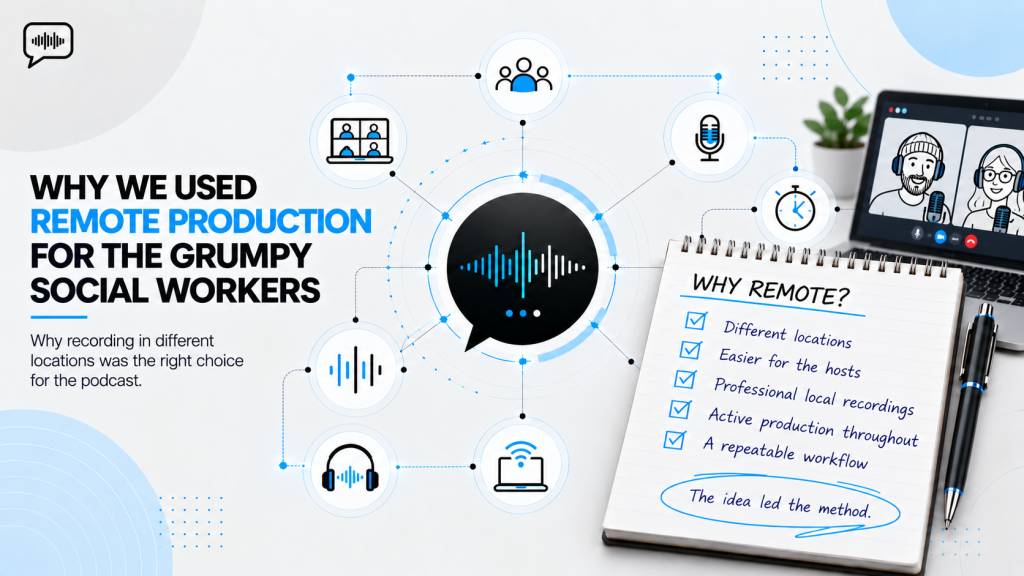
Siobhan was in one location, Soyeb was in another and I was producing the sessions from Manchester. We used Riverside to bring everybody together and to capture local recordings of each participant, rather than relying solely on the compressed sound travelling through the call itself.
But the technology was only one part of making that work.
A remotely recorded conversation can very quickly feel like three people sitting in separate boxes on a laptop if nobody thinks about the experience beyond getting everyone connected. Delays can interrupt the natural rhythm, people can talk over each other because the usual physical cues are missing, somebody can drift too far away from the microphone and technical distractions can start taking attention away from what they were actually trying to say.
That is where production matters.
Before the sessions began, we made sure everybody understood how the recording would work, checked the technical setup and dealt with the things that could get in the way before they had a chance to interrupt the conversation. During the sessions, I could then concentrate on monitoring what was happening technically while also listening to the shape of the episode itself.
From Siobhan and Soyeb’s perspective, the aim was for the process to become fairly invisible.
They shouldn’t have to spend the conversation watching meters, wondering whether something was recording or thinking about what would happen if a file went missing. They had enough to think about in the subject itself.
My job was to worry about the production so they didn’t have to.
Making the process easier for the hosts mattered
This was Siobhan’s first experience of making a podcast, which is another reason I didn’t want the production process to become unnecessarily complicated.
People sometimes assume that before somebody can make a professional podcast they need to understand microphones, recording software, audio formats, hosting platforms and all the other pieces of technology sitting behind the finished episode.
They really don’t.
Siobhan and Soyeb brought the important part: years of experience in social work, strong opinions about the profession and a relationship that could carry a conversation. There would have been very little value in turning them into part-time audio engineers before they were allowed to use any of that.
So rather than handing over a list of technical requirements and leaving them to work everything out themselves, we guided them through what they actually needed to know at each stage.
Where to sit. How to use the microphone. What to check before we started. What would happen once the recording finished.
Enough understanding to make the process comfortable, but not so much technical information that making the podcast started to feel like another job.
That is something I think good production should do regardless of whether the recording is remote, in a studio or on location. The people creating the content should be able to concentrate on creating the content.
Everything else should support that.
Remote production still needs somebody producing it
One of the easiest mistakes to make with remote podcasting is to confuse remote recording with simply sending somebody a link.
The software has made that possible. You can create an online studio, email the participants, let them join and end up with individual files afterwards.
Technically, you have recorded a podcast.
But production involves more than creating files.
During The Grumpy Social Workers, I stayed with every recording session from beginning to end. While Siobhan and Soyeb were talking, I was monitoring what was being captured, keeping an eye on levels and recording status, watching for technical problems and listening to the conversation as a producer rather than simply waiting for it to finish.
Sometimes that means saying nothing.
If two hosts are having a genuinely interesting exchange, the worst thing a producer can do is keep interrupting simply to demonstrate that they are producing. There were plenty of moments where the best decision was to let the conversation go where it naturally wanted to go.
At other points, an idea needed returning to, something needed clarifying or we needed another version of a section because a technical problem had interrupted it.
That judgement is still part of the production whether everybody is sitting around the same table or spread across three locations.
The interface changes.
The responsibility doesn’t.
The audio still had to stand up afterwards
The convenience of remote recording would not have meant very much if the finished episodes sounded poor.
That was one of the reasons we used a platform that could record each participant locally rather than simply recording the sound coming through an internet call. Riverside captured separate high-quality recordings for each participant, which gave us considerably more control once the session moved into post-production.
That distinction matters.
During a live remote conversation, what you hear is affected by the connection between participants. There might be a momentary drop in quality or a slight glitch in what somebody hears during the call, but the locally captured recording can remain much cleaner because it is being recorded at the participant’s end before being uploaded afterwards.
It isn’t magic. The microphone, room, positioning and behaviour of the person recording still matter, and there are limitations that would not exist in a carefully controlled studio.
But it gives us proper material to work with.
Once the files came back into the production process, the fact that the conversation had happened remotely became less important than the quality and consistency of the individual recordings. We could edit the conversation, balance the voices, deal with distractions, work on pacing and integrate the wider sonic identity of the programme in exactly the same way we would approach any professionally produced series.
The audience doesn’t need to spend the episode thinking about the recording method.
Ideally, they stop noticing the production altogether and listen to what is being said.
We didn’t try to make the conversation too perfect
There is another side to this that matters particularly with a podcast like The Grumpy Social Workers.
The series was not supposed to sound like two people reading carefully approved statements.
The whole point was that Siobhan and Soyeb could talk openly about social work, draw on their own experience, disagree with each other and occasionally head somewhere we hadn’t anticipated when the episode was being planned.
Remote recording gave us a structure in which that could happen quite comfortably.
They were both recording from familiar environments rather than arriving at an unfamiliar studio, sitting under lights and being suddenly very aware that they were making a programme. For some podcasts that studio experience creates useful energy. For others it can make people slightly more self-conscious than they normally are.
Here, familiarity helped.
Once a session was underway, it began to feel less like a formal recording and much more like the kind of conversation the podcast was supposed to capture. They could laugh, interrupt each other occasionally, change their minds and follow interesting tangents without the production constantly reminding them that there was a microphone there.
We still gave the episodes shape. We had clear subjects and discussion prompts, and the conversations were edited afterwards to improve pacing and clarity.
But we weren’t trying to remove the rough edges that made Siobhan and Soyeb sound like Siobhan and Soyeb.
That personality was the reason to make the podcast in the first place.
There were compromises, because there always are
I wouldn’t pretend remote production is perfect.
If everybody is in a professionally treated studio with an engineer controlling every microphone, there is more control over the recording environment. You know exactly what the room sounds like. You can position microphones precisely. You can see everybody properly. You can react physically to the conversation and there is no internet connection sitting between the participants.
Remote recording asks you to give up some of that control.
People are recording in different rooms. One person might have a harder space than another. Somebody can accidentally move away from the microphone halfway through an answer. A delivery driver can choose the exact wrong moment to knock on the door. Internet connections can create awkward pauses that slightly change the rhythm of an exchange.
Those things need managing.
But production is nearly always about managing a set of trade-offs rather than finding some imaginary setup where every possible variable has disappeared.
A location recording might give you an extraordinary setting but introduce background noise. A studio gives you technical control but adds cost and travel. Remote production gives participants far more flexibility while asking the production team to deal with differences between individual recording environments.
The useful question isn’t whether one method is universally better.
It is whether the advantages of a particular approach make sense for the thing you are trying to create.
For this series, they did.
Post-production is where the separate locations came back together
Once a recording session finished, the remote part of the process was effectively over.
From that point on, we had individual recordings that needed turning into an episode.
That involved the same detailed decisions that sit behind most of the work we do at One Stop Podcasts: choosing where the conversation genuinely needed tightening, dealing with technical distractions, balancing the voices, improving consistency and shaping the pacing without making the discussion sound unnaturally edited.
It also meant bringing the wider identity of the programme into every episode.
We had created bespoke sonic branding for The Grumpy Social Workers, including its theme and branded intro and outro, so those elements became part of the structure around the conversations. The recordings may have started in different geographical locations, but by the time somebody pressed play they needed to feel like parts of one recognisable series.
That consistency is particularly important with remote production because the raw material can naturally contain more variation.
The aim isn’t to make two different voices sound identical. It is to make the differences feel intentional rather than distracting.
If one person is slightly louder, one recording has more low-frequency energy or one room is a little more apparent than another, those differences can pull attention away from the conversation if they are left unmanaged.
A lot of the work happens precisely so the listener never has to think about any of that.
It also gave the project room to continue
There was another advantage that became clearer once we had established the workflow.
We now had a repeatable way of making the programme.
Siobhan and Soyeb did not need to reserve a studio every time they wanted to record. They did not need to travel to Manchester or arrange a location that happened to be equally convenient for everybody. We had already worked out how the sessions would run, how the recordings would be captured and what would happen once they finished.
That matters if a podcast is going to develop beyond its first series.
One-off production decisions are relatively easy to justify. The bigger test is whether the production model still makes sense when you imagine doing it again next month, or across another six episodes, or with a guest joining from somewhere completely different.
Remote production gives The Grumpy Social Workers that flexibility.
It means a future guest does not necessarily need to be within travelling distance of a particular studio. It means recording can fit more easily around professional commitments. It means we can continue to provide active production without geography becoming the thing that decides whether an episode is possible.
That doesn’t mean every future recording has to be remote.
If there is a reason to get everybody into a studio, we can do that too.
The important thing is that the podcast isn’t trapped by its production method.
What the project reinforced for us
Working on The Grumpy Social Workers reinforced something fairly simple.
Professional production and complicated production are not the same thing.
It would have been very easy to make this project more elaborate. We could have hired a studio, introduced more equipment, arranged travel and built a recording day around the fact that we were making a podcast.
None of those things would automatically have made the podcast better.
Instead, we kept asking what would help Siobhan and Soyeb have the conversations the series was built around, and what we needed to put around those conversations so that the finished programme still felt consistent, considered and professionally produced.
Remote recording answered that question well.
It made the sessions easier to organise, allowed everybody to work from their own location and gave the hosts a comfortable environment in which to talk. Behind that relatively simple experience was a production process dealing with preparation, recording, monitoring, editing, audio processing, sonic branding, quality control and release.
That distinction is important.
Simple for the people making the podcast does not necessarily mean simple behind the scenes.
Often, good production is precisely what makes the experience feel straightforward.
Remote, studio or location should come after the idea
We continue to offer all three approaches because they solve different problems.
There are podcasts I would absolutely recommend recording in a studio. There are others where going to the contributor’s workplace or another meaningful location adds something that would be lost anywhere else. And there are projects where bringing people together remotely gives us everything the podcast needs without introducing unnecessary logistics.
The decision should come fairly late in the thinking.
First: what are we making?
Who needs to be involved?
What kind of conversation are we trying to create?
What will make those people comfortable enough to contribute properly?
What does the audience actually need from the finished result?
Then we can decide where everybody should sit.
For The Grumpy Social Workers, that meant Siobhan in one place, Soyeb in another and One Stop Podcasts producing from a third.
Three locations could easily have become the problem we spent the whole project trying to overcome.
Instead, we built the production around it.
And once the microphones were on and the conversation started, where everybody happened to be sitting became one of the least interesting things about the podcast.
Thinking about making a podcast remotely?
Remote production can be a very effective way to make a podcast, particularly when hosts, guests or organisations are spread across different locations, but simply recording an online conversation is not quite the same thing as producing one.
The useful part is building a workflow that makes the technology easy for the people taking part while still giving the finished podcast the consistency and production quality it needs.
At One Stop Podcasts, we can produce remotely, in a professional studio or on location, and we will normally recommend the approach based on what you are actually trying to make rather than pushing every project towards the same setup.
If you’ve got people worth bringing together and a conversation worth recording, tell us what you’re thinking.
We’ll help you work out the best way to make it.