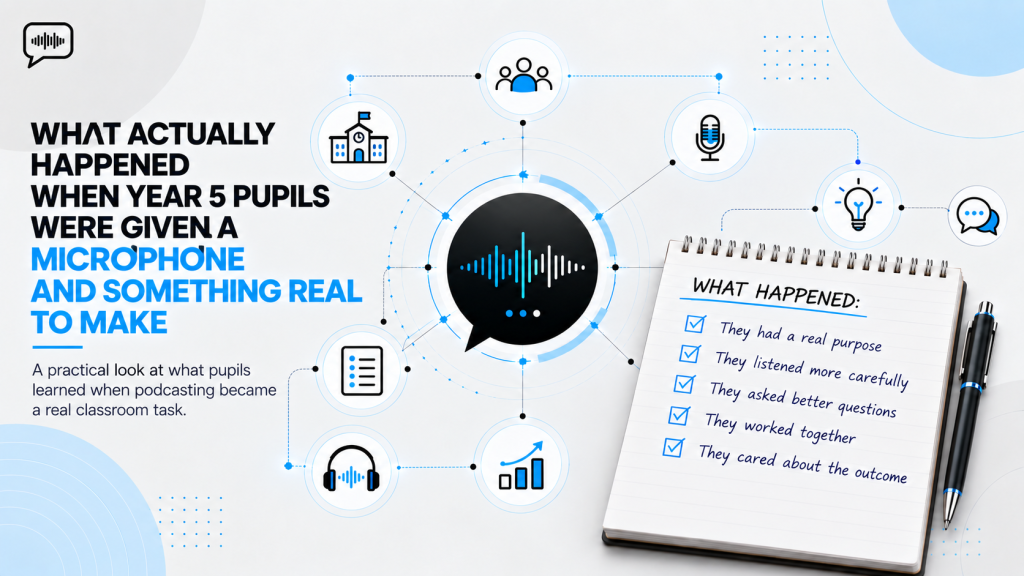
There is something that changes when you put a microphone in front of a group of pupils and tell them they are going to make something that somebody else could actually listen to.
I saw that again recently while working with Year 5 pupils at Stansfield Hall Primary School, and it was a useful reminder of why podcasting in primary schools can work so well when the activity starts with something real for pupils to make.
The session was built around introducing the pupils to podcasting, but I did not want to spend too long standing at the front explaining what a podcast is, how microphones work or what all the different jobs are. They needed a little bit of that to get started, but the interesting part was always going to come once they began making something themselves.
And that is exactly what happened.
The microphone got their attention. Making something gave it a purpose.
There is obviously an immediate novelty in using microphones and recording equipment in a primary classroom. Pupils want to have a go, they want to hear themselves back and they are curious about what everything does.
That is useful, but I don’t think the equipment on its own is what makes podcasting interesting as a learning activity.
The bigger change came when the pupils realised they were not simply practising speaking or completing an exercise. They were trying to make a podcast that had to make sense to somebody listening.
Suddenly there were decisions to make.
What are we actually going to talk about? How do we start? Who is going to speak first? What questions should we ask? Is that answer interesting enough? Does this make sense if the listener cannot see what we are looking at?
Those conversations began quite naturally because there was a reason for them.
The pupils were not being asked to communicate well because I had written “communication skills” on a lesson plan. They needed to communicate well because otherwise the thing they were making would not work.
That is a small distinction, but I think it is an important one.
We didn’t spend ages learning about podcasting before making one
One thing I try to avoid with these workshops is turning podcasting into another subject pupils have to sit and learn about before they are allowed to do anything.
There is certainly some basic knowledge they need. We talked about speaking towards the microphone, listening to the person you are talking to, avoiding everybody speaking at the same time and thinking about what the listener needs to understand.
But after that, we got into making.
Once they started developing ideas and recording, most of the useful learning came from the problems they encountered along the way.
A question might not lead anywhere, so they had to change it. Somebody might speak too quietly, so they had another go. Two people might start talking over each other and realise very quickly why that does not work particularly well in an audio recording.
None of that needed a long explanation from me beforehand.
They could hear it.
And because they could hear it, they understood why it mattered.
Different pupils found different ways to contribute
This was probably one of the things I found most interesting about the session.
Podcasting can look, from the outside, like quite a performance-based activity. You might assume the pupils who benefit most are the confident speakers who are happy to pick up a microphone and talk.
There were certainly pupils who were immediately comfortable doing that, but the activity was not really dependent on everybody being the same type of communicator.
Some pupils were good at asking questions. Others were better at organising the group or remembering what still needed to be recorded. Some were naturally good at listening and picking up on something another pupil had said. Others took a bit longer before they were comfortable speaking, but had strong ideas once they did.
That is one of the things I like about using podcasting in this way. There are lots of ways into it.
You need people to speak, but you also need people to listen, plan, question, organise, solve problems and decide what should happen next.
The microphone might be the most visible part of the activity, but it is only one part of what the pupils are actually doing.
Listening became just as important as speaking
We often talk about podcasting in schools in relation to oracy, confidence and speaking skills, and there is an obvious connection there.
But during the session I was reminded again that good podcasting depends just as much on listening.
If somebody gives you an answer and you are already thinking about your next question, the conversation becomes quite mechanical. If you actually listen to what they have said, there is a chance to follow it somewhere more interesting.
The pupils started to pick up on that.
They listened to one another, responded to what had just been said and began to understand that a conversation is not simply a series of people waiting for their turn to talk.
The same thing happened when they listened back to recordings.
Was that clear?
Could we hear everybody?
Did that introduction work?
Should we do that bit again?
Listening became part of making the podcast rather than something they were being reminded to do.
The equipment stopped being the interesting bit surprisingly quickly
At the start, naturally, there was a lot of interest in the microphones and the recording setup.
That did not last very long.
Once the pupils had something they wanted to record, the technology became what it should be: a tool for helping them make it.
They did not need to know everything about microphones or audio production. They needed to know enough to use the equipment properly and enough to recognise when something was not working.
Why does that person sound much quieter?
Why can we hear somebody tapping the table?
What happens if two people speak at once?
Should we move a little closer to the microphone?
Those are technical questions, but in the context of actually making something they stop feeling particularly technical. They become practical problems with fairly obvious consequences.
That is a much more useful way to introduce this kind of technology than asking pupils to remember a long list of terminology before they have any reason to care about it.
There was a real reason to get it right
The podcast did not need to be perfect.
That was never the point.
But because the pupils were making something they could listen back to and potentially share, there was enough at stake for them to care about the result.
You could see that in the way they approached recording.
If somebody stumbled over a sentence, they wanted another go. If part of the conversation did not quite work, they were happy to improve it. If an introduction felt a bit flat, they started thinking about how they could make it better.
It was not about chasing technical perfection.
It was simply that the work had an audience beyond the teacher standing in the room, even if that audience was only imagined at that stage.
The possibility of somebody listening changes things.
It gives pupils a reason to think about how they come across, whether their ideas are clear and whether what they have made is actually worth listening to.
And they wanted to hear what they had made
This is probably the simplest part of the whole experience, but it matters.
The pupils wanted to hear the recording.
They wanted to know what it sounded like.
They wanted to recognise their own voices and the bits they had contributed.
There is a different feeling when a piece of work comes back to you as something that exists outside the classroom task itself.
It is not just a page that has been completed and handed in.
They made something.
They could listen to it.
Other people could listen to it.
And they were proud of that.
The podcast was really just the vehicle
By the end of the session, the pupils had experienced quite a lot of podcasting without us needing to turn the whole thing into a lesson about podcast production.
They had thought about an audience, developed ideas, planned what they wanted to say, listened to other people, asked questions, worked together, used recording technology and made decisions about how they wanted the finished result to sound.
That is why I think podcasting has so much potential in education.
It can look like a media activity, and of course it is.
But the podcast itself is often just the thing that brings everything else together.
You can tell pupils that speaking clearly is important, but it becomes much more obvious when they listen back and cannot quite understand what somebody has said.
You can talk about the importance of asking good questions, but that lesson lands differently when a weak question brings the conversation to a complete stop.
You can discuss teamwork, listening and collaboration, but those things have more meaning when a group has something they are trying to make together.
At Stansfield Hall, the microphones helped create the excitement.
What mattered more was what happened after they were switched on.
The pupils had something to talk about, people they needed to work with and something real they were trying to make.
That gave the rest of the learning somewhere to go.
Could podcasting work in your school?
Podcasting in the Classroom does not need to mean building a studio or launching a school podcast that has to run forever.
Sometimes the best place to start is much smaller.
A class. A topic. A project. A group of pupils with something worth talking about.
From there, podcasting can become a practical way of bringing together speaking, listening, creativity, collaboration and digital skills around something pupils genuinely want to make.
If you are thinking about how podcasting could work in your school, college or classroom, take a look at our Podcasting in the Classroom workshops and teacher CPD, or get in touch with One Stop Podcasts to talk through what might work for your pupils.