There is an assumption built into the word podcast that once you start one, you are supposed to keep going.
Episode one becomes episode two, then episode ten, then somebody notices you have not released anything for three months and starts asking whether the podcast has quietly stopped.
That model works brilliantly for some shows. If there is a steady supply of ideas, an audience worth building over time and enough resource to keep making good episodes, an ongoing podcast can become a valuable part of an organisation’s communications.
But it is not the only way to do it.
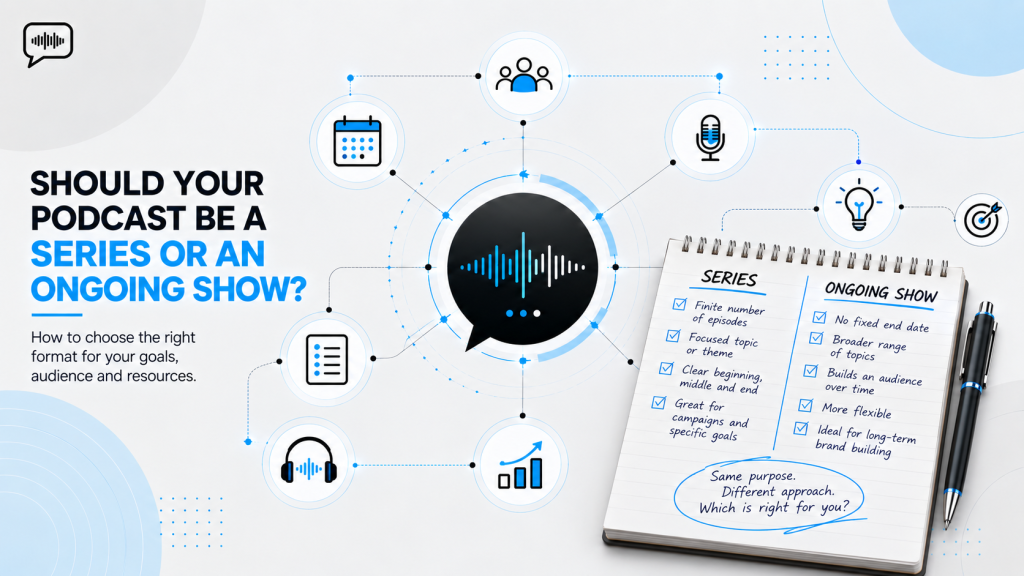
Sometimes a podcast series with a clear beginning and end is a much better idea. Six episodes might be enough. Perhaps eight or ten. The point is not to make fewer episodes for the sake of it, but to choose a production model that actually fits what the podcast is there to achieve.
Before deciding how often to publish, I would decide whether the idea is something that genuinely needs to keep going.
Start with the job the podcast needs to do
A useful place to begin is the purpose.
If the podcast has been created around a specific subject, campaign, project or group of people, there may already be a natural end point.
Imagine an organisation wants to explore six areas of its work through conversations with the people responsible for each one. That sounds like a six-part series to me. Turning it into an indefinite weekly podcast simply because podcasts are supposed to continue would create a new problem: what happens after episode six?
The same is true of a podcast connected to an event, research project, anniversary, internal change programme or particular campaign.
Sometimes the idea has boundaries.
That is useful, not limiting.
A finite series allows the format to be designed around those boundaries rather than pretending there is an endless supply of episodes waiting to be discovered.
An ongoing podcast makes more sense when the underlying reason for making it continues too. A business that regularly has new expertise, stories, guests or ideas to share may have plenty to work with. An industry-focused show might have a continuous stream of developments worth discussing.
The production model should follow the idea.
A series gives everybody something concrete to commit to
Starting a podcast can feel like a surprisingly large promise.
If you tell a busy managing director, communications team or group of subject specialists that you want them involved in a podcast every month indefinitely, the enthusiasm in the room can change fairly quickly.
Six episodes feels different.
There is a clear piece of work to complete. Recording dates can be planned. Guests can be identified. Budgets can be agreed. Everybody knows roughly what they are committing to and when that commitment ends.
That can make a series easier to get started, particularly inside organisations where the podcast is only one of many things competing for people’s time.
It also creates an opportunity to learn.
Make the six episodes. See how the audience responds. Find out which parts of the process worked well and which were harder than expected. Then decide whether another series is worth making.
You have not failed to create an ongoing show.
You have completed a series and now have evidence to inform what happens next.
A finite series can be easier to shape editorially
There is something useful about knowing the destination.
If you are creating eight episodes around one broad subject, you can look at the series as a whole rather than treating every episode as an isolated piece of content.
What belongs at the beginning?
Which ideas need introducing before others make sense?
Are there two episodes covering almost the same ground?
Is something important missing?
Could the final episode bring some of the ideas from earlier conversations together?
That starts to feel less like filling slots in a publishing calendar and more like producing a body of work.
It does not mean the episodes have to be heavily scripted or connected like chapters of an audiobook. Each can still work perfectly well on its own.
But having a defined number encourages you to think about what the complete series says when somebody encounters all of it.
Ongoing shows have a different advantage
There is a reason many successful podcasts do continue.
Time creates familiarity.
Listeners get to know the host, the structure and the kinds of conversations they can expect. The podcast can respond to new ideas and developments rather than being tied entirely to a plan created months earlier.
An ongoing show also gives an organisation more opportunities to be discovered.
One episode might attract a relatively small audience. Fifty good episodes create fifty potential ways for somebody to find the podcast through a guest, a search result, a recommendation or a piece of related content.
The archive itself can become useful.
Someone may discover episode 46 and then work backwards through earlier conversations because the subject is relevant to them.
That compounding effect is much harder to create with a short series.
But it only works if the podcast is worth continuing.
Publishing forty episodes because forty is more than six is not automatically a content strategy.
Do you genuinely have enough to talk about?
This sounds obvious, but it is worth asking early.
A lot of podcast ideas are really three good episodes wearing a twenty-four-episode plan.
During initial planning there is usually plenty of enthusiasm. People suggest guests, themes and questions very quickly. The list grows.
Then you look more closely.
Several topics are versions of the same conversation. Some guests have been included because somebody happens to know them rather than because they add anything important. A few episode ideas could probably be useful sections inside another episode.
That is not necessarily a problem.
It might simply mean you have found the shape of the series.
I would rather make six genuinely worthwhile episodes than stretch the idea until episode fourteen exists mainly because the publishing schedule says something needs to go out on Thursday.
An ongoing podcast needs a repeatable source of material.
If you cannot see where that material will come from after the initial burst of ideas, a series may be the more sensible choice.
Think about the people required to make it happen
The audience matters, but so does the organisation producing the podcast.
Who is going to host it?
Who finds the guests?
Who prepares the conversations?
Who approves the edits?
Who creates the supporting content and makes sure the episode actually gets published?
A monthly podcast does not sound particularly demanding when you describe it as twelve recordings a year. In practice, every episode brings a small chain of work with it.
That becomes much easier when there is a reliable production process around the show.
If the podcast depends on one enthusiastic person finding spare time every few weeks, an indefinite commitment can become difficult very quickly.
A finite series gives you the chance to resource the project properly for a defined period.
An ongoing show needs a system that can survive busy months, staff changes, holidays and the point six months later when launching a podcast no longer feels new.
Budget works differently too
There is a practical financial distinction between commissioning a series and committing to ongoing production.
A six-episode project can usually be scoped as one piece of work.
You can establish the strategy, production requirements, recording approach and deliverables, then understand what the whole thing is likely to cost.
Ongoing production has different advantages. Once the initial format and workflow are established, the process can become increasingly efficient, and the podcast can develop rather than being rebuilt each time.
But it is still a recurring commitment.
That matters when the podcast includes video, studio hire, multiple guests, short-form content, bespoke editing or other production elements.
I would rather have an organisation invest properly in a focused series than choose an ambitious ongoing format that gradually has to be stripped back because the original commitment was unrealistic.
Sustainability is part of the strategy.
A series does not have to be the end
This is probably the part that makes the choice less dramatic than it first appears.
You can make another series.
A six-part podcast can return with a second run if there is a good reason to continue. The next series might explore a different theme, introduce a new format or build on what you learned from the first one.
There can even be useful space between them.
Rather than feeding a publishing schedule continuously, the organisation has time to look at what happened. Which episodes travelled furthest? Which guests created the strongest conversations? Did the audience respond to the subjects you expected?
Then the next series can be better.
There is no rule saying a podcast has to choose between existing forever and disappearing forever after episode six.
Seasonal production can sit comfortably between those two extremes.
Do not call something a season unless there is a reason
I would make one distinction here.
Sometimes podcasts label everything as seasons even though nothing really changes between them.
Episode 20 becomes the end of Season Two. Episode 21 arrives two weeks later and is called Season Three. Same format, same subjects, same schedule.
There is nothing particularly wrong with that, but the season label is not doing much.
A genuine series or season is more useful when the boundary means something.
Perhaps each series explores a different theme. Maybe the guest profile changes. There could be a planned break for production and evaluation. An internal podcast might align each series with a stage of an organisational programme.
The audience does not necessarily need an elaborate reason, but there should ideally be some logic behind the structure.
Otherwise you may simply have an ongoing podcast with occasional changes to the episode numbers.
An ongoing podcast needs permission to evolve
The opposite problem can happen when organisations commit to an ongoing show and then treat the original format as permanent.
The first ten episodes teach you things.
Perhaps thirty minutes sounded right during planning but the best conversations naturally settle around twenty. Maybe a regular segment nobody was sure about turns out to be the strongest part of the show. A type of guest you expected to work brilliantly may consistently produce weaker episodes than people closer to the day-to-day subject.
An ongoing podcast should be allowed to respond to that.
Consistency is useful, but it should not become stubbornness.
The advantage of producing something over time is that you get evidence. You can listen to the programme, look at how people respond and make sensible adjustments.
The format should become clearer as the podcast develops.
Think about what happens after the final planned episode
One of the simplest questions I would ask during podcast strategy is:
What happens after the episodes we have currently planned?
If everybody immediately has another twenty worthwhile ideas, you may be looking at an ongoing show.
If the honest answer is “we would need to come up with something”, that tells you something too.
There is no need to solve a problem you do not actually have.
A strong six-part podcast remains a strong six-part podcast when it finishes. The episodes continue to exist. They can still be discovered, shared, embedded into websites, used by sales teams or turned into other forms of content.
Stopping at the point the idea has been properly explored is not the same as abandoning it.
Sometimes finishing is part of doing the project well.
Decide what you can make well, not what sounds most ambitious
“Ongoing podcast” can sound more substantial in an early meeting.
It suggests commitment. A content programme. Something that will grow.
That can absolutely be the right direction.
But a defined podcast series can be equally strategic, and sometimes considerably more realistic. It gives you room to focus the subject, secure the right people, invest properly in the production and create something complete.
There is no prize for producing the most episodes.
I would decide based on the strength of the idea, the audience, the amount of useful material available and the organisation’s ability to support the production over time.
If those things point towards an ongoing show, build one that can genuinely continue.
If they point towards six excellent episodes with a clear purpose and a natural ending, make those instead.
Then see what deserves to happen next.