Some podcast briefs arrive with pages of detail.
Others amount to little more than: “The client wants to start a podcast.”
Both can create problems.
A very detailed brief can lock decisions in before anybody has worked out whether they make sense for the podcast. At the other end of the scale, a production team cannot do much with a title, a vague audience and the instruction to make something that “feels engaging”.
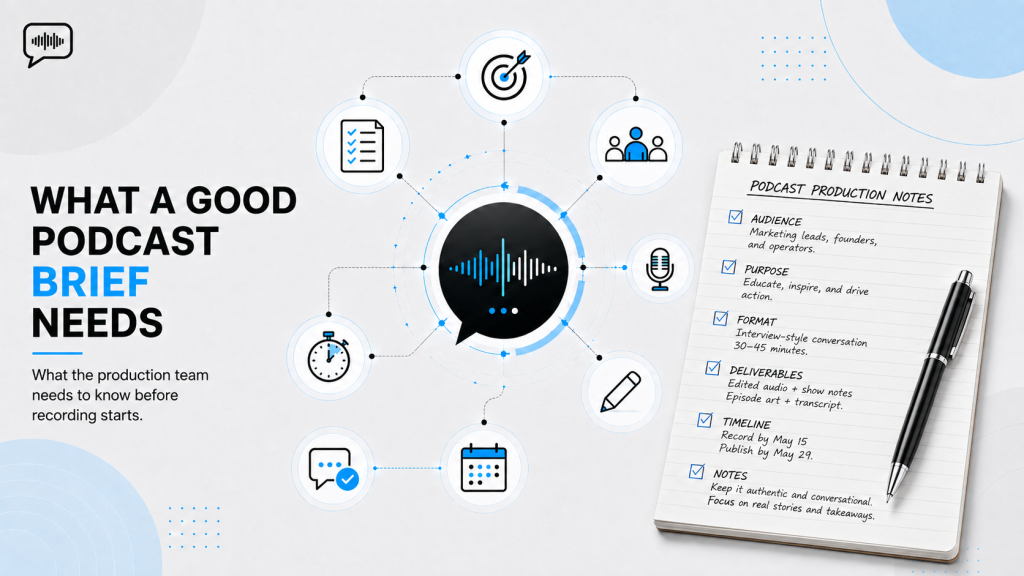
A useful podcast production brief sits somewhere between the two.
It gives the people making the podcast enough context to understand what the client is trying to achieve, who the work is for and what has already been decided. It also leaves enough room for production expertise to shape the parts that have not.
For agencies, getting this right makes a noticeable difference. It cuts down on duplicated conversations, avoids assumptions being made in different places and gives everyone something useful to work from.
Start with why the podcast exists
This is the part I would want before almost anything else.
Why is the client making a podcast?
Maybe they want to demonstrate expertise. Perhaps the aim is internal communication, customer education, recruitment, thought leadership or giving a particular community a voice. The podcast might sit inside a broader campaign, or it may be intended to develop into a long-term piece of content in its own right.
Those are quite different jobs.
“Create a six-part podcast” tells the production team what needs delivering, but it does not explain what success looks like.
If we understand what the podcast is there to do, we can make better decisions about format, hosts, guests, episode length, tone and production style.
Without that, everybody is choosing those things largely on taste.
Describe the audience as clearly as you can
“Business owners” is an audience.
It is not necessarily a very useful one.
A podcast aimed at somebody running a five-person creative agency may need to behave differently from one aimed at senior leaders in a multinational organisation, even though both groups technically contain business owners.
The brief does not need an elaborate fictional audience persona with a name, salary and preferred supermarket.
It does help to know who the client genuinely hopes will listen.
What do those people already know about the subject? Why might they care? Where are they likely to encounter the podcast? What would make an episode useful enough for them to come back?
That information influences more than the marketing.
It changes the language, level of explanation, choice of guests and sometimes the whole format.
Tell us where the podcast fits
For an agency project, the podcast rarely exists in isolation.
It may be one part of a brand campaign, a thought-leadership programme, an internal communications strategy or a wider content plan. There may already be visual guidelines, messaging, audience research and campaign objectives that are relevant to the production.
That context is useful.
If an agency has spent months developing a particular positioning for a client, there is little value in a podcast team arriving and inventing an entirely separate personality for the show.
This is one of the areas where white-label podcast production works particularly well. The agency already understands the wider brand and relationship. The production team brings the specialist knowledge needed to translate that into a podcast.
The brief is where those two things start meeting.
Separate what is decided from what is still open
This can save a lot of unnecessary back and forth.
Perhaps the client has already chosen the host and confirmed six guests. That is decided.
Maybe somebody has suggested forty-minute episodes, but nobody is especially attached to the number. That is still open.
The brief should make the difference clear.
Otherwise ideas have a habit of turning into requirements simply because they appeared in an early document.
I would much rather see something like:
Confirmed: monthly interview series hosted by the CEO.
To develop: episode structure, duration, sonic identity, video approach and distribution.
That tells us where useful production thinking is still needed.
It also prevents everybody spending time reopening decisions the client has already made.
Give us the practical deliverables
“Podcast production” can describe quite a few different services.
Does the agency need audio episodes only?
Audio and full video?
Short clips?
Show notes?
Transcripts?
Artwork?
Sonic branding?
Publishing and distribution?
There is no reason every podcast needs all of those things, but the production team needs to understand what the expected output actually is.
This becomes particularly important when video and repurposed content are involved.
A recording designed only to produce a finished audio episode may be approached differently from one expected to generate a YouTube version, six vertical clips, stills and promotional material for the next month.
The earlier that is understood, the easier it is to plan the production around it.
Clarify who is responsible for what
This is one of the least glamorous parts of a brief and one of the most useful.
Who is booking the guests?
Who sends joining instructions?
Who approves the episode?
Does feedback come directly from the client or through the agency?
Who supplies artwork and brand assets?
Who publishes the finished episode?
If nobody has answered those questions, they will eventually answer themselves, usually when somebody discovers a task has not been done.
With white-label work, we often adapt to the agency’s preferred way of working. Some agencies want all client communication to run through them. Others want us to handle the recording logistics directly while approvals remain with the agency.
Either model can work.
Ambiguity is the bit that causes trouble.
Explain how approvals will work
Podcast feedback can become surprisingly messy when several people are involved.
One person wants a section removed. Somebody else wants it restored. The host sends comments directly to the editor while the agency is collecting a different set from the client’s communications team.
A good brief should establish the approval route before the first episode gets there.
Ideally, somebody owns the consolidated feedback.
That might be the agency account lead, the client or somebody inside the production team, depending on the project.
The important thing is that the editor receives one clear set of instructions rather than trying to interpret several competing conversations.
It also helps to agree how many rounds of amendments are expected and what counts as a genuine production correction rather than the project gradually being rewritten during post-production.
Give us the brand without over-directing the sound
Brand guidelines are useful.
A list of five adjectives followed by “make it sound like this” is slightly less useful.
Audio has its own language.
Words such as professional, friendly, confident and contemporary can all point in several directions once you start choosing voices, music, pacing and production style.
If there are existing brand materials, campaign work or examples of how the organisation communicates elsewhere, share them.
If the client has heard podcasts they like, those references can be helpful too, particularly if they can explain what they like about them.
The production team can then interpret that information rather than simply copying another show.
A podcast should feel connected to the organisation without sounding as though somebody has converted the visual brand guidelines into audio one bullet point at a time.
Include the timeline, including the bits before launch
A launch date on its own does not tell us very much.
Before a podcast can go live there may be strategy work, guest booking, recording, editing, artwork, music, approvals, revisions, hosting setup and distribution to deal with.
If the first episode needs to launch on a particular date, the useful question is how much time exists before that date to do everything properly.
The same applies after launch.
Are episodes weekly, fortnightly or monthly? Are several being recorded in advance? Does the client have an approval process that regularly takes ten working days?
Those things belong in the production schedule.
A realistic timeline is much more useful than an ambitious date everybody quietly knows will move.
Budget matters because it changes the solution
There can be some reluctance to include budget in a brief because nobody wants to reveal too much too early.
I understand that.
But the budget influences the production model.
A remote audio series has different requirements from a multi-camera studio production with bespoke music, animation and ten promotional clips per episode.
Without at least some sense of the available budget, a production team can easily spend time developing an approach that was never realistic.
It does not need to mean spending every penny available.
It simply gives the conversation sensible boundaries.
Often there are several ways of approaching a podcast, and knowing those boundaries helps us recommend the version that gives the client the most value rather than the version with the longest equipment list.
Leave room for questions
A good brief should make the project clearer.
It does not need to finish the thinking.
In fact, if every creative and production decision has already been made before the production team sees the project, some of the value of bringing in a specialist has been lost.
There should still be questions.
Is this the strongest format for the audience? Does the proposed episode length make sense? Is video worth the additional production? Could the same recording create more useful content elsewhere? Is the host the right person to carry the conversation?
Those questions are part of developing the podcast.
The brief gives us somewhere useful to begin asking them.
A good brief gets everybody starting from the same place
That is really what I want from it.
Not a forty-page document.
Not every microphone model and camera angle decided before the first call.
Just enough clarity that the agency, client and production team understand the same project.
Why are we making it?
Who is it for?
What has been decided?
What are we delivering?
Who owns each part?
When does it need to happen?
Once those things are clear, the more interesting production conversations can begin.
And they usually become considerably easier.