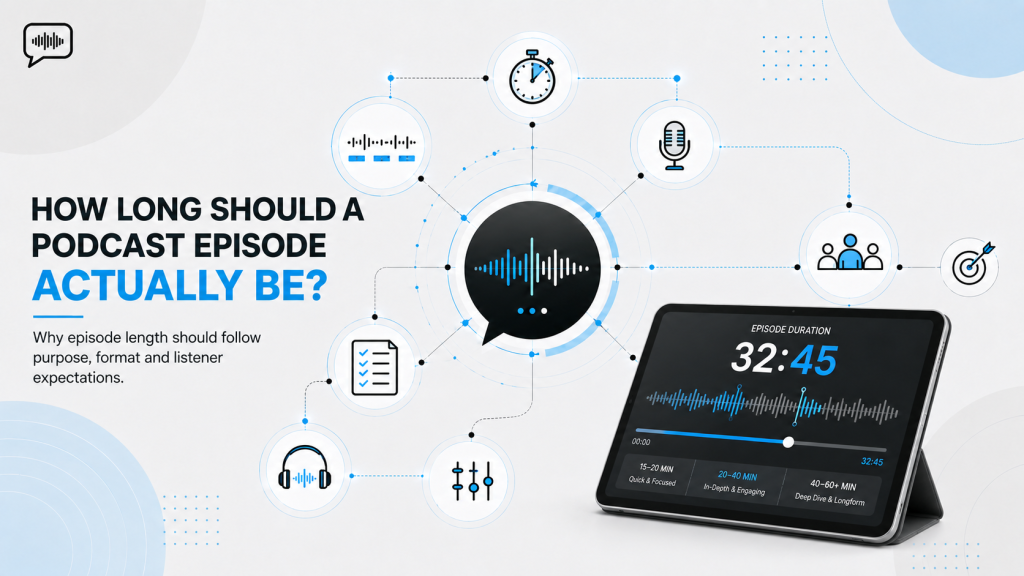
One of the first questions people ask when they are planning a podcast is how long the episodes should be.
Twenty minutes? Half an hour? An hour?
There must be a correct answer somewhere, because plenty of successful podcasts seem to settle into a fairly predictable length. Look around for advice and you will find people confidently recommending everything from ten-minute episodes to conversations that run well beyond an hour.
I do not think there is a useful universal number.
A forty-five-minute episode can disappear quickly when the conversation is good. Fifteen minutes can feel surprisingly long when it is not.
Podcast episode length matters, but probably not in the way people first assume.
Start with what the episode is actually trying to do
Before deciding how long an episode should be, I would ask what needs to happen during it.
A short practical podcast answering one specific question might only need ten or fifteen minutes. An interview exploring somebody’s career, ideas or experiences may need considerably longer. A documentary or narrative series will have its own rhythm again.
Trying to force all of those into the same thirty-minute box would be fairly arbitrary.
This comes back to something I wrote about in Why Your Podcast Needs a Reason to Exist. Once you are clear about who the podcast is for and what you want the listener to get from it, many of the production decisions become easier.
Length is one of them.
If the purpose of an episode is clear, you can start asking whether the material is doing enough to justify the listener’s time rather than simply watching the clock.
The listener is giving you their time
I think this is the more useful way to look at it.
Every episode asks somebody for a chunk of their day.
That might be twelve minutes while they walk to work or ninety minutes during a long drive. Neither is inherently better. The question is whether what you are giving them feels worth that amount of attention.
Listeners are remarkably tolerant of length when they are interested.
People will happily listen to a long conversation when they feel they are learning something, enjoying the company or waiting to hear where the discussion goes next. Equally, they will abandon a much shorter episode if it takes five minutes to get to the point.
So the goal is not necessarily to make the podcast short.
It is to avoid making it longer than it needs to be.
Do not confuse duration with depth
There is an assumption that longer episodes are somehow more substantial.
Sometimes they are.
A thoughtful hour-long interview can go somewhere that a fifteen-minute conversation simply cannot. The extra time gives the guest room to develop an idea, tell a story and move beyond the answer they have probably given dozens of times elsewhere.
But extra minutes do not automatically produce extra depth.
A conversation can repeat itself. An answer can wander long after the interesting part has passed. Hosts can spend ten minutes introducing something the listener already understood from the title.
Long-form podcasting works when the time creates space for something worthwhile to happen.
When it does not, it is just long.
Short episodes have their own pressures
Shorter podcasts are not automatically easier to make either.
In some ways they are harder.
If an episode is only ten minutes long, there is not much room for a slow introduction or a question that does not lead anywhere. The structure has to work. The host needs to know what the episode is there to achieve and the edit may need to be more disciplined.
That can be a very good thing.
A short format forces decisions.
What does the listener genuinely need? Which example earns its place? Is this section useful, or is it only here because it happened during the recording?
For organisations with a very focused idea, shorter episodes can work extremely well because they make a relatively small promise to the audience and then deliver it quickly.
Think about when people are likely to listen
The audience can also influence the shape of the episode.
If you are creating something for busy professionals who are likely to listen between meetings or during a commute, a focused twenty-minute format may fit their lives particularly well.
That does not mean those same people would never listen to an hour-long podcast. Plenty will. But their behaviour is worth thinking about.
The same applies in other contexts.
An internal company podcast might work better when episodes are short enough to fit naturally into the working day. A specialist interview series may attract an audience that actively wants longer, more detailed conversations. An educational podcast aimed at explaining one topic may benefit from a tighter format again.
Audience behaviour should inform the decision without turning into another rigid rule.
Consistency helps, but it does not have to mean identical
There is something useful about listeners having a rough idea of what they are getting.
If most episodes of a podcast sit somewhere around twenty-five to thirty-five minutes, people begin to understand the commitment involved. That familiarity can help a series develop its own rhythm.
I would not worry if one episode is twenty-two minutes and another is thirty-eight.
Trying to make every episode exactly thirty minutes can create strange editing decisions. Suddenly useful material is being cut because the clock says twenty-nine minutes, while weaker conversations are stretched because the format supposedly demands another seven.
A range is often more useful than an exact duration.
It gives the podcast some consistency without making the number more important than the episode.
Guests can change the answer
Interview formats are particularly difficult to standardise because people communicate differently.
Some guests answer a question brilliantly in two minutes.
Others need time to get there.
One person might tell detailed stories and naturally create a forty-five-minute conversation. Another may have equally useful things to say but do it in twenty-five.
That is fine.
The job of the host and producer is not necessarily to make both recordings the same length. It is to recognise where the useful material is and shape the episode around it.
Sometimes that means allowing a conversation to breathe. Sometimes it means recognising that everything the listener needs has already been said.
Knowing when to stop is part of the production.
Editing should earn back the listener’s time
This is where editing becomes important.
Recording length and episode length do not have to be the same thing.
A fifty-minute conversation might contain an excellent thirty-five-minute episode. There may be repeated points, technical interruptions, sections that go nowhere or simply moments that were pleasant in the room but do not add much for somebody listening later.
Removing those things is not about making the podcast unnaturally slick.
It is about respecting the audience.
I like the idea that an edit should give the listener some of their time back. If we can remove five minutes without losing anything worthwhile, there is usually a good argument for doing it.
Not every pause needs cutting and not every answer needs tightening. Natural conversation still needs room to sound natural.
But there is a difference between allowing something to breathe and leaving everything in because editing it would take longer.
Video adds another consideration
Video podcasts make the length question slightly more complicated.
Someone may happily listen to an hour-long conversation while doing something else, but watching an hour of two people sitting in a studio asks for a different kind of attention.
That does not mean long video podcasts do not work. Clearly they do.
It does mean you should think about what the video version is for.
Maybe the full conversation belongs on YouTube while shorter sections are used elsewhere. Perhaps the video audience behaves differently from the audio audience. Or maybe the podcast is primarily audio and the cameras are there to provide useful clips around the main episode.
The same recording can serve several formats without every format needing to be consumed in exactly the same way.
Your production schedule matters too
There is also a practical side that gets forgotten when people choose formats.
A weekly ninety-minute podcast creates a lot more material to record, edit, review, publish and potentially turn into video and social content than a twenty-minute monthly episode.
If you are planning a podcast for an organisation, sustainability matters.
It is much better to create a thirty-minute format you can produce properly for a year than commit to an enormous weekly production that everybody is tired of by episode six.
The right podcast format has to work for the audience, but it also has to work for the people making it.
That is one of the things we consider when developing new Podcast Packages. The production model has to be realistic enough that the podcast can keep happening once the excitement of launching it has worn off.
Let the episode tell you when it is finished
If somebody asked me for an ideal podcast episode length, I could give them a number.
Thirty minutes sounds sensible. So does forty-five. Both would be right often enough to appear convincing.
But I do not think either would be especially useful.
I would rather start with the audience, the format and what the episode is meant to achieve. Record enough to explore it properly. Then listen back and be prepared to remove whatever is not earning its place.
Sometimes the result will be fifteen minutes.
Sometimes it will be an hour.
The more useful question is not:
How long should a podcast episode be?
It is:
At what point has the listener got what they came for?
That is probably where the episode should end.