Podcast content repurposing works best when the original conversation is worth spending time with.
That sounds obvious when you look at how organisations are using video, LinkedIn, newsletters and short-form content, but I still think podcasting is sometimes planned as though the finished episode is the only thing being made. Somebody records a conversation, it gets edited, published to Spotify or Apple Podcasts, perhaps shared once on social media, and then everyone moves on to the next one.
There is nothing wrong with that if the podcast itself is the main objective. But if you have already brought the right people together, prepared a useful subject and recorded a genuinely good conversation, there is usually far more value sitting in that recording than a single episode.
The important bit is having something worth working with in the first place.
Start with the conversation, not the content calendar
There is a lot of pressure on organisations to keep producing content. LinkedIn posts, videos, newsletters, articles, clips, website updates. The list gets long very quickly, and trying to come up with separate ideas for every channel can become a job in itself.
Podcasting gives you another way to approach that.
Instead of beginning with ten empty boxes in a content calendar and asking what should go into each one, you can begin with one subject that is worth talking about and give it enough room to develop properly.
Sit two knowledgeable people down for forty minutes and ask useful questions. Let them explain something, disagree, tell stories, go off in an unexpected direction or get into the detail that would never fit into a short social post.
Now there is something to work with.
Some of that conversation will belong in the podcast. Other moments might work better as a short video, a written article or a quote. A particular answer might spark an entirely separate post. You might discover three more subjects you had not planned to talk about at all.
That feels much more useful to me than trying to manufacture ten unrelated pieces of content because ten pieces of content are required.
The podcast can be the source material
Take a fairly straightforward video podcast recording.
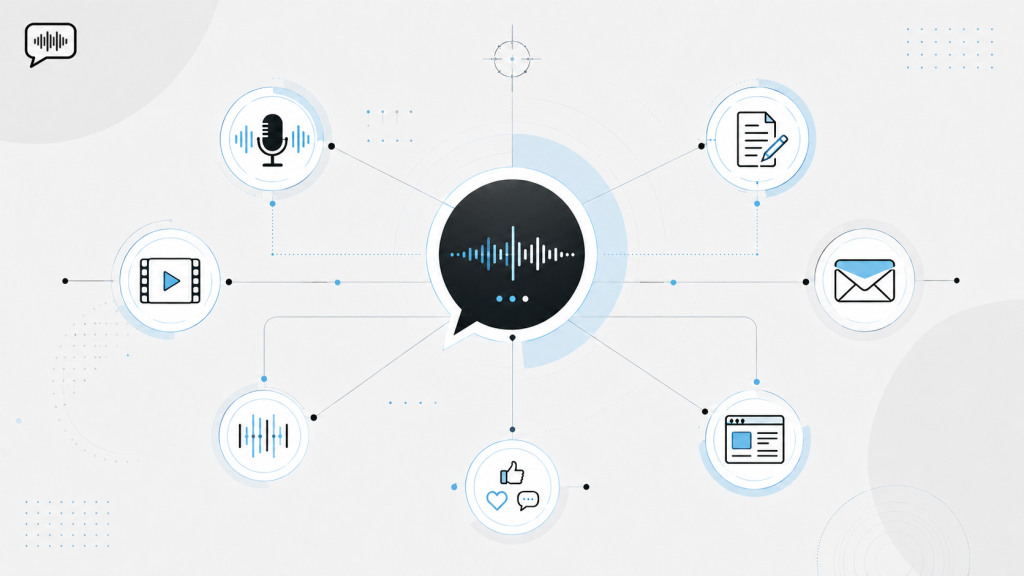
From that one conversation you might end up with the full audio episode and a full video version for YouTube. There may be several short clips that work on LinkedIn, Instagram or elsewhere, particularly if somebody makes a useful point that stands on its own.
The transcript might contain the bones of an article. A strong section of the discussion could become a newsletter. Quotes might be useful for social posts, and the wider subject could give you material to update a service page or FAQ on your website.
You might also decide that some of it should not become anything else at all.
That matters too.
Repurposing does not mean chopping every sentence into another asset. Sometimes the best thing you can do is recognise that a conversation has given you two or three genuinely useful additional pieces rather than trying to squeeze twenty-seven bits of content out of it.
The aim should still be to make things people might actually want to spend time with.
Different formats need different treatment
This is where I think the word “repurposing” can occasionally be a bit misleading.
It makes the process sound almost mechanical. Record the podcast, press a button and out comes a LinkedIn post, an article, five reels and a newsletter.
You can certainly automate parts of that workflow, and some of the tools are getting very good, but the strongest results usually need a bit more thought.
A two-minute answer that works brilliantly inside a conversation might need to be cut differently to work as a sixty-second video. A transcript is not automatically an article. Spoken language often needs restructuring before it feels natural on the page, and a good LinkedIn post probably needs a clearer point than simply copying a paragraph from the episode description.
The source can be the same without every version feeling the same.
That is one of the things I like about this approach. You are not endlessly inventing new things to say. You are finding the right way to express a useful idea in different places.
It also changes how you plan a podcast
Once you start thinking this way, podcast planning becomes slightly different.
The question is no longer only “what would make a good episode?”
You might also think about whether the subject has enough substance to create other useful material. Are there questions that could produce clear standalone answers? Is there something visual worth capturing? Could the conversation reveal ideas that would be useful to customers, colleagues or a wider community?
I would still be careful not to let that thinking ruin the podcast itself. A conversation becomes tedious very quickly if every answer is being engineered to create a clip.
The episode has to work first.
But with a little planning, you can make sure the recording gives you enough quality material to work with afterwards without making the conversation feel artificial.
This is particularly useful when expertise already exists
A lot of organisations already have the raw material for good content.
The problem is often getting it out of people.
Someone inside the organisation may know an enormous amount about a subject but never find the time to sit down and write an article about it. Another person might have years of experience that rarely makes it onto the company website because nobody has quite worked out how to capture it.
Ask them good questions in a conversation and suddenly that knowledge starts appearing.
People often find it easier to explain an idea out loud than to stare at an empty document and work out how to write 1,000 words about it. They react to questions, remember examples and make connections they might not have thought to include in a formal piece of writing.
That is where podcasting can become genuinely useful as a content process, not just another distribution channel.
You still need a reason to make the podcast
There is an obvious danger here.
If the only reason for making a podcast is to generate clips for LinkedIn, you may not actually need a podcast. It might be quicker and cheaper to record a series of short videos.
The podcast itself still needs to justify the listener’s time.
That is why I would always start with the conversation and the audience rather than the list of outputs you hope to produce from it. If the discussion is interesting and useful in its own right, the additional content becomes a bonus rather than the thing holding the whole idea together.
It also tends to produce better material because people are actually talking about something rather than delivering pre-planned soundbites.
One good conversation can go a long way
For me, that is one of the most useful things about podcasting.
You create the time and space for somebody to say something properly. You capture the voice, personality and detail that often gets stripped away when everything has to fit into a few lines on a screen.
Then you decide what else is worth doing with it.
Maybe that becomes a video, three clips and an article. Maybe it becomes a newsletter and a couple of good social posts. Another episode might barely need anything beyond the podcast itself.
There does not need to be a fixed formula.
The value is having a strong piece of source material that gives you choices afterwards.
One conversation. Much more content.
But the conversation has to be worth having first.