It is very easy to make podcast production look like an equipment problem.
Spend five minutes online and you can disappear into comparisons of microphones, cameras, interfaces, lighting, acoustic panels and whatever piece of kit somebody has decided is essential this week. I understand the appeal. I work in audio, and I’m as interested in good equipment as anybody else who has spent too long thinking about how something sounds.
But equipment only solves part of the problem.
A great microphone will capture a dull conversation very clearly. An expensive camera will give you a beautifully sharp picture of somebody who looks uncomfortable. You can have an impressive studio, technically perfect levels and flawless video, but if nobody has thought carefully about what is being recorded, who is listening or how the conversation should work, the result can still feel strangely flat.
Good production is much broader than the kit sitting on the table.
The recording starts before anyone presses record
Some of the most useful production decisions happen before there is anything to record.
Who is taking part? What are they actually there to talk about? Does everybody understand the purpose of the episode? Are there particular questions or subjects worth spending time on? Is somebody going to lead the conversation, or are four people about to sit around a table hoping that something interesting happens?
None of this needs to mean scripting every answer. In fact, over-preparing can make a podcast feel just as lifeless as under-preparing. But giving people enough structure to know where the conversation might go usually makes the recording much easier.
It also means you can think about practical things properly. If somebody is joining remotely, is their environment suitable? If the conversation is likely to be quite personal, would a large studio full of cameras change how comfortable they feel? If the episode involves several people, is there enough time for everybody to contribute without the whole thing becoming an hour and forty minutes long?
Those are production decisions too.
People matter more than the signal chain
You can spend a lot of time getting a microphone positioned perfectly and then completely ignore the person sitting behind it.
Some people are immediately comfortable when they start recording. Others become very aware of the microphone, the headphones, the camera and the fact that every sentence is suddenly being captured. You can hear the difference.
A good recording environment should help people forget some of that.
Sometimes that means having a short conversation before recording properly rather than immediately counting down from three. It might mean explaining that mistakes can be edited, that an answer can be started again, or that nobody needs to deliver everything perfectly in one take.
It can also mean knowing when not to interrupt.
If somebody is getting into an interesting story, the technically neat thing to do might be to steer them back towards the planned question. The better production decision may be to let them keep going for another minute and see where it leads.
The technical side matters, but it is there to support the conversation rather than control it.
Editing is not just removing mistakes
Once the recording is finished, another set of decisions begins.
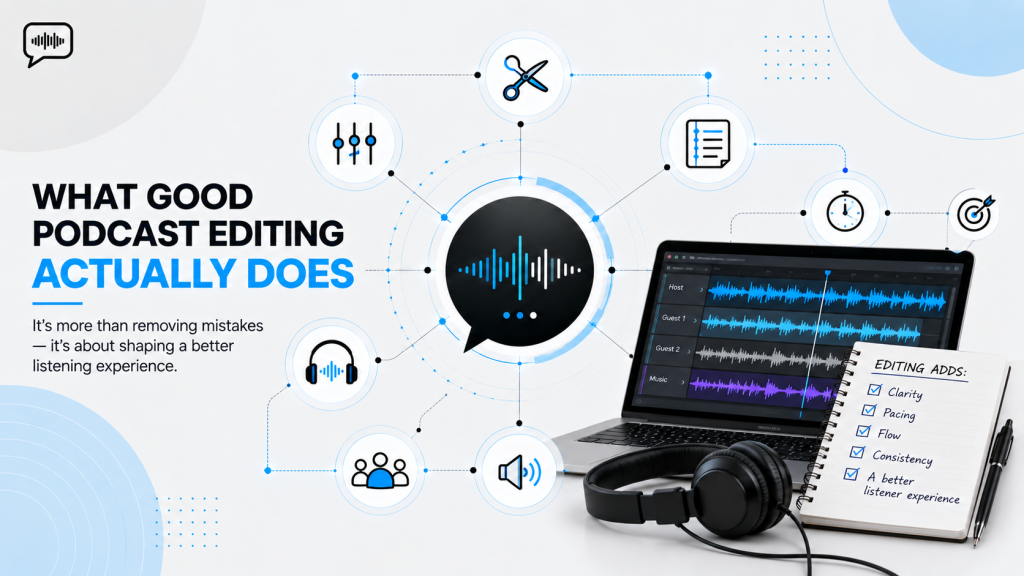
Editing is sometimes described as though the job is simply to remove ums, mistakes and long pauses. Those things can be part of it, but a good edit is usually doing something more subtle.
You are shaping the listener’s experience.
Maybe an answer takes three minutes to reach a point that could be made in ninety seconds. Perhaps the conversation goes off somewhere interesting but never finds its way back. There might be a section that felt important in the room but sounds repetitive when you listen again the next day.
Editing can help with all of that, but it is very easy to go too far.
I generally want an edit to make somebody easier to listen to without making them sound like a different person. Real conversations have pauses, changes of direction, laughter and moments where somebody thinks before answering. Remove every trace of that and you can end up with something technically clean but slightly strange to listen to.
The best editing often goes unnoticed.
You just hear a conversation that seems to move well.
Sound influences how the podcast feels
There is another part of production that sits somewhere between the technical and creative sides.
How should the podcast actually feel?
Two podcasts can use the same microphones and be recorded in the same room but have completely different identities. The difference might come from the pace of the edit, the amount of room sound left in, the way music is used, how the introduction works or simply how close and present the voices feel.
Music can be useful here, but it should have a reason to be there. A theme, sonic logo or short transition can help give a series its own identity, while dropping generic music underneath every spoken section can just as easily get in the way.
The same applies to processing.
Compression, EQ, noise reduction and all the other tools available in post-production can make a recording sound considerably better, but there is no prize for using all of them. Sometimes the right production decision is to do less.
The aim is not to make the listener notice how much processing has happened.
It is to make the podcast feel right.
Video changes the production, not just the format
Video podcasting has made all of this more complicated in an interesting way.
Adding cameras is not simply a case of recording the same podcast and putting pictures on top. Suddenly lighting matters. Eyelines matter. The background matters. People become more aware of how they are sitting, where they are looking and what happens when they reach for a drink halfway through an answer.
Editing changes too.
A cut that disappears completely in audio might look very obvious on video. Removing a section of somebody’s answer may require changing camera angles or finding another visual way through the edit. If short clips are part of the plan, framing and composition need to work for those formats as well.
That does not mean every podcast needs a complicated multi-camera production. Quite often it does not.
But if video is being added, it is worth treating it as a genuine production decision rather than a box that has to be ticked because podcasts are supposed to be filmed now.
Consistency is part of the job
One good episode is relatively easy to produce.
Doing it again next month, with the same standard, is where a production process starts to matter.
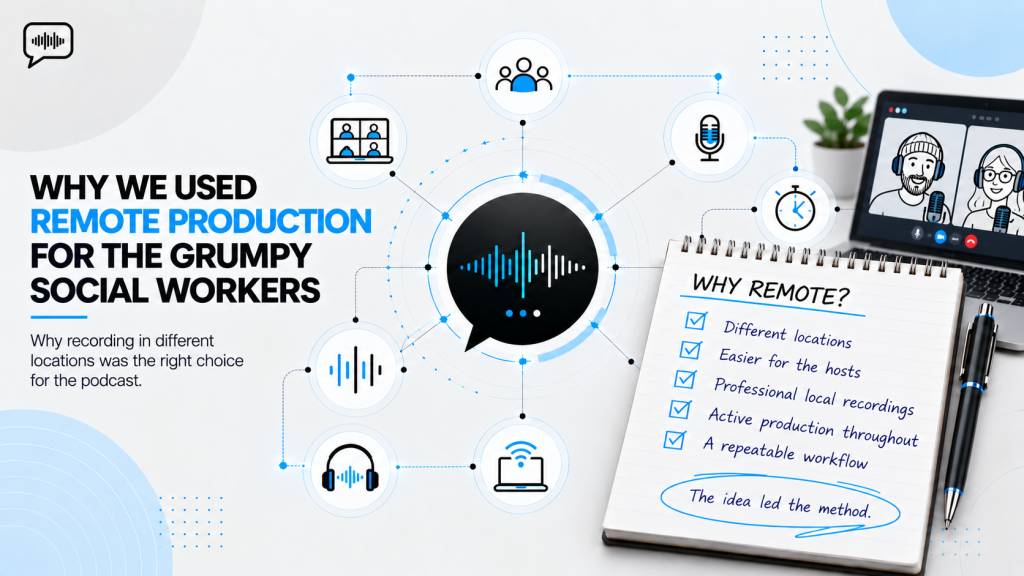
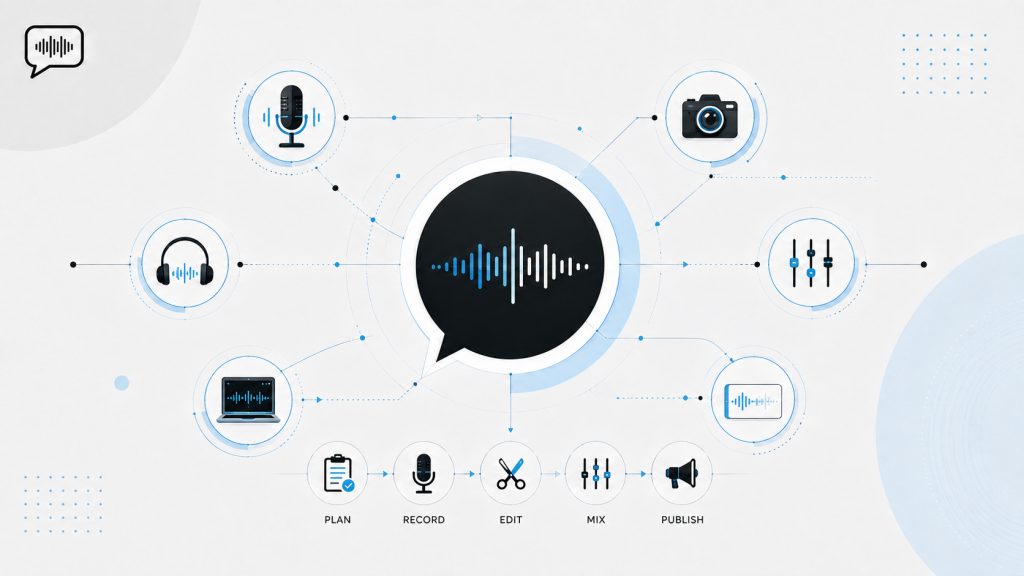
Files need to be organised. Recordings need to happen reliably. People need to know what they are responsible for. Artwork, descriptions, clips and distribution need to happen at the right point rather than being remembered twenty minutes before the episode is due to go live.
This becomes even more important when a podcast involves several people or sits inside a larger organisation.
A clear production workflow is not particularly exciting, but it prevents an enormous amount of unnecessary work. It also means more attention can go into the episode itself rather than repeatedly solving the same practical problems.
That reliability is part of what professional production should provide.
The equipment should eventually disappear
Good equipment matters. I would never argue otherwise.
A suitable microphone makes recording easier. A well-treated room gives you fewer problems later. Good cameras, lighting and monitoring all make a difference when they are being used properly.
But listeners rarely come back because they recognise the microphone.
They come back because the conversation was interesting, the episode respected their time, the sound did not distract them and the whole thing felt considered enough that they wanted another one.
That is the part of podcast production I find most interesting.
The technology should help make that possible, and then mostly get out of the way.