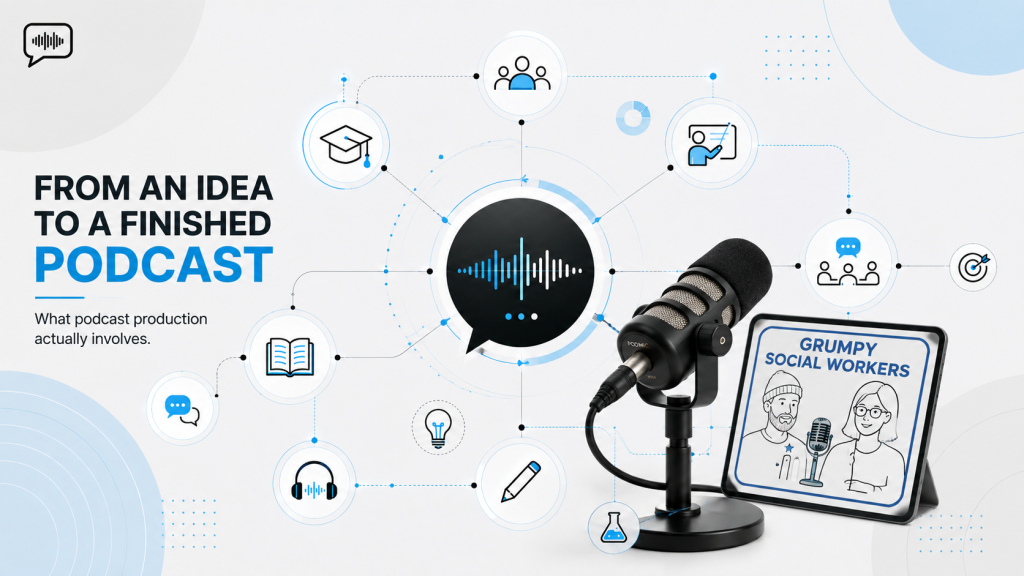
When Siobhan Maclean and Soyeb Aswat first started talking to us about The Grumpy Social Workers, they already had plenty of the things a good podcast needs.
Years of experience in social work. Strong opinions. Interesting subjects to explore. And, importantly, a natural way of talking to each other.
What they didn’t have was experience of making a podcast.
That wasn’t a problem.
You don’t need to understand microphones, recording platforms, editing, distribution or any of the other technical parts of podcasting to have a good idea for one.
You need something worth talking about.
The rest can be worked out.
Working out what the podcast should be
Before we recorded anything, we spent time developing the idea with Siobhan and Soyeb.
The Grumpy Social Workers was never supposed to be a heavily scripted or overly polished professional podcast. The appeal was in hearing two experienced social workers talk openly about a profession they knew extremely well.
Sometimes they would agree. Sometimes they wouldn’t.
That was part of what made it interesting.
So rather than writing scripts, we developed the series around episode themes and discussion prompts. Each episode had somewhere to go, but there was enough room for the conversation to develop naturally.
Across the six episodes they explored supervision, professional identity, anti-oppressive practice, virtual working, artificial intelligence and some of the wider pressures facing social work.
The subjects could be serious. The podcast didn’t always have to sound serious.
That balance became an important part of the show.
Giving it an identity of its own
The name did a lot of work from the beginning.
The Grumpy Social Workers tells you something about the podcast before you’ve heard a second of it. There’s a bit of humour in it, a bit of provocation and a fairly good indication that this isn’t going to be two people carefully avoiding difficult opinions.
We wanted the rest of the production to feel consistent with that.
That meant thinking about the tone and positioning of the series, but also how it should sound.
We created an original theme for the podcast and developed bespoke intro and outro sections around it. The aim was to give the series a recognisable sonic identity without making it feel overly produced or corporate.
The music didn’t need to be the star of the show.
It just needed to belong to this show.
Recording from three different places
Siobhan and Soyeb weren’t sitting opposite each other in a podcast studio.
In fact, none of us were in the same place.
The series was recorded remotely using Riverside, with Siobhan, Soyeb and One Stop Podcasts joining from three different locations.
That made the practical side of recording much easier for everyone, but remote doesn’t mean leaving people to log into a platform and hoping for the best.
We prepared each session, checked the setup, managed the Riverside studio and monitored the recordings while the conversation was happening.
We were also listening to the programme itself.
If a subject needed more time, we could let it develop. If something particularly interesting appeared in the conversation, there might be an opportunity to explore it further. And if Siobhan and Soyeb were in full flow, often the best production decision was simply to stay out of the way.
They could concentrate on talking to each other.
We could concentrate on everything else.
As Siobhan later said:
“I had no idea about podcasts — I had never even listened to one — but Craig was great at helping me to understand and took me step by step through the process.”
Knowing what to leave in
There is a temptation with podcast editing to think that more editing means better production.
It doesn’t.
A conversation can be technically immaculate and still feel lifeless.
With The Grumpy Social Workers, much of the character came from the relationship between the hosts. The pauses, reactions, disagreements and moments where the conversation went somewhere unexpected were often the things worth keeping.
Post-production was about making those conversations work better for the listener.
We brought together the locally recorded audio from each location, removed technical interruptions and unnecessary distractions, refined the pacing and balanced the voices.
Each episode was then mixed, mastered and combined with the show’s theme, intro and outro.
There was plenty of technical work involved.
The listener shouldn’t really be thinking about any of it.
They should be listening to Siobhan and Soyeb.
Getting six episodes ready to go
Once the episodes were finished, there was still work to do.
We prepared the series for Spotify, Apple Podcasts and YouTube, developed episode titles and descriptions, refined the show notes and managed the distribution process.
We also supported the launch communications and checked everything was appearing where it should.
All six episodes were released together.
For this particular series, that made sense. Someone discovering The Grumpy Social Workers didn’t have to hear one episode and wait to find out whether there would be another. They could immediately explore the series, get to know the hosts and hear the range of subjects they wanted to discuss.
An idea had become an actual body of work.
Podcast production is bigger than editing
This project is a useful example of why we think about podcast production as more than what happens to an audio file after recording.
There was strategy involved.
There was format development, recording, production, music, sonic branding, editing, mixing, mastering, distribution and launch support.
But those things weren’t separate jobs being bolted together one after another.
They were all decisions about the same podcast.
The format affected how we recorded it. The personalities of the hosts affected how we edited it. The name and tone affected the sonic identity. The audience affected how the whole thing needed to be presented.
That’s the part of podcast production that can sometimes get overlooked.
The microphones matter. Good editing matters. Getting the technical details right matters.
But none of those things can tell you what the podcast should be.
That has to come from the idea and the people behind it.
Siobhan and Soyeb brought both.
Our job was to help turn them into The Grumpy Social Workers.